
Why Gerrit is torn about showreels
Gerrit says he is “extremely torn” about showreels. When someone applies, he always watches the reel, because as a casting director he finds it really interesting to see how someone acts. On the other hand, in his view bad showreels pull the impression down for no good reason. They end up working against the actor and don’t necessarily reflect how well someone really acts.
What often tips the balance for him is the technical side. A dull edit where picture and sound always change at the same point, without so-called J and L cuts, and with only two shot sizes, so hardly any switching between close and wide: that makes any performance less interesting, however good it might be. And over his career Gerrit has seen far more bad showreels than good ones.
He knows it sounds self-serving when someone from a company that makes showreels criticises exactly that. He adds: “But unfortunately it’s unironically true.” What that means for your reel, whether you shoot it yourself or not, is in the sections below.
What a showreel needs
- Brevity. Agencies and casting offices often watch many reels in a row. Whether they stay with yours is decided at the start.
- Best first. Your strongest scene goes up front, not saved as a climax for the end.
- You. Close-ups, your face, your voice. The reel should show how you act, not how pretty the film was.
- Good sound. People forgive a slightly soft image, not an echoing room. If they can’t understand you, nobody listens to your acting any more.
Shooting it yourself: what works with a phone and friends
A current smartphone films well enough. What makes the difference is everything around it:
- Light: Stand sideways to a window, not with your back to it. Light from the side gives your face shape; the ceiling light from above puts shadows under your eyes.
- Sound: A clip-on mic on your collar is close to your mouth; the phone’s built-in mic mostly hears the room. A room with carpet, curtains and furniture echoes much less than an empty kitchen.
- Partner: Play a scene with someone who gives you something back. A monologue straight into the camera quickly looks like a self-tape.
- Editing: You don’t need to spend anything on it. DaVinci Resolve is free and does more than you need for a showreel. More important than any effect is cutting ruthlessly.
- Variety in the edit: The shot size is how much of you is in the frame: close-up mostly your face, medium shot from the waist up, wide shot the whole room. So shoot each scene several times from different distances, and you can switch in the edit. And don’t let picture and sound always change at the same moment: with a J cut you hear the next shot before you see it; with an L cut the sound of the previous shot carries on after the picture has changed. That way a conversation flows instead of falling apart into pieces.
Where it falls apart: You can often tell a home-made reel by scenes that don’t connect, light that jumps from shot to shot and sound that wavers. And if you act, direct and edit at the same time, you rarely see yourself from the outside.
Footage from your films
If you’ve already acted in short or feature films, your best showreel may already be in the footage. Ask the productions whether they’ll give you your scenes, ideally in full quality rather than clipped from the finished film. And ask right away whether you’re allowed to use them in your showreel.
Having it made: what you get
The outside view is the biggest difference. With us, Gerrit directs. He writes and directs our short films and sometimes stands in front of the camera himself, so he knows both sides.
- Fast: From your inquiry to the finished showreel usually takes about a week, if we find a shooting date quickly.
- Focused: Half a shooting day fits one or two scenes. Better a few that show what you can do.
- With new scenes: If you don’t have a scene of your own, Gerrit writes some for you. That’s included in the price too.
- With a partner: Ideally you bring your scene partner along. If that doesn’t work out, we’ll find someone.
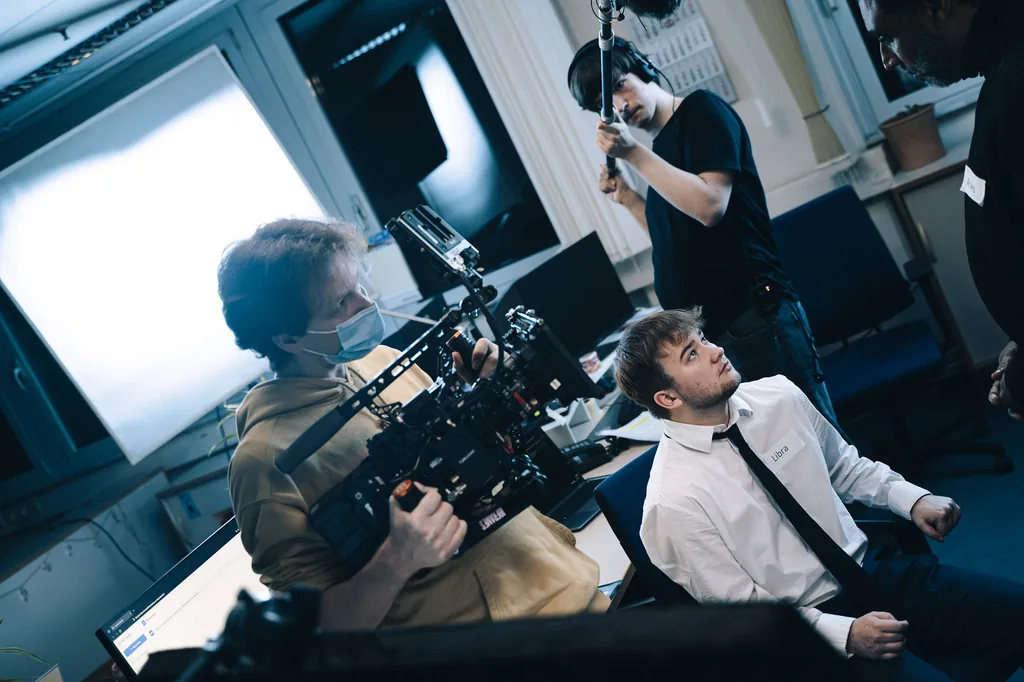
You can see what that looks like in our iact Showreels project: in autumn 2023 we shot showreels for eight students of the internationale Schauspiel-Akademie für Film und Theater (iSA) in Hamburg. What a showreel costs with us and everything that’s included is on our production page. You’ll also find the About-Me video there, if you’d rather show yourself than a role.
Typical mistakes
- Too long. Not everything you’ve ever shot belongs in the reel. Better a few scenes, well chosen.
- Snippets without context. A look, a cut, the next look, and nobody understands what’s going on. Give each scene a moment so the situation comes across.
- Bad sound. Better one scene fewer than one where nobody can understand you.
- Dull editing. Hard cuts where picture and sound always change together, and hardly any change in shot size. According to Gerrit, that’s often why a reel doesn’t convince. J and L cuts and a few switches between close and wide help, as described above under shooting it yourself.
- Long intros. Your name fits on a title card at the start or the end. Nobody needs an intro with music and slow-motion shots.
- Old footage. If you look different today than in the reel, it no longer shows you.
Which way is right for whom?
Shooting it yourself makes sense if you’re just starting out, need something to show quickly or already have good footage from films that only needs editing. As long as the edit doesn’t get dull.
Having it made makes sense if you lack footage, are applying to agencies or your home-made reel hasn’t shown what you can do so far.
Not sure? Write to us about what you have in mind. Sometimes a tip is all it takes, and you end up shooting it yourself after all.